Showing posts with label environment. Show all posts

Wednesday, August 15, 2007

Monbiot and Reducing Climate Change


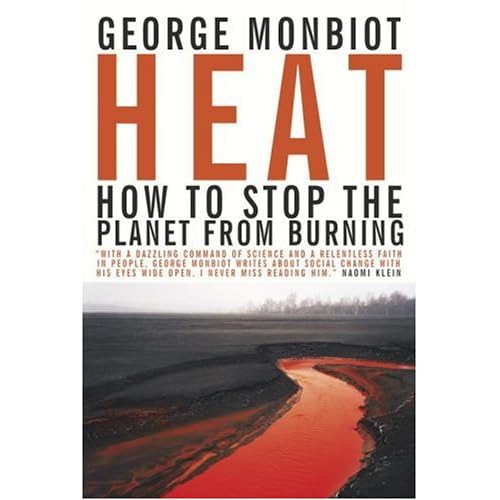
I read George Monbiot's Heat last week (which makes this post very outdated indeed...). Its very good, everybody should read it. The thing is that it deals with how it is possible to, with a decent amount of probability, prevent that global warming goes into the beyond tolerable. It will be hard but doable.

The effect this book had on me is that I now feel ready to act. Monbiot basically shows what needs to be done, now we have to get about doing it. It won't be enough just to change one's own life, we have to start putting pressure on those in power.

Here is a good interview that will give you a good idea about what needs to be done (and why for those of you who do not know that). My favorite line is the one comparing what is required from us to face this crisis compared to WWII.

You say that flying less is a sacrifice too great for the people of this country to bear. But the last time the world was faced with an existential crisis - the rise of the Axis powers - millions of people were asked to sacrifice their lives to prevent it. Now, we are being asked to sacrifice our holidays in Florida and Thailand.

Part 1, Part 2, Part 3, Part 4. (YouTube)

Now, there are some things about which I do not agree with Mr. Monbiot. They are not central to the argument. He essentially says that the controversy over what the scientific position on climate change is cause by people not understanding what science is. This I think is only part of the problem. Climate change reveals problems in the very scientific method itself. It clearly seems to be beyond what is possible for todays scientists to reach a scientific conclusion about the entire phenomenon. All the experts deal with small aspects in which the method works, but it seems that when it comes to compiling all this data it is no longer possible to keep the same methodical stringency. Hence the controversy over IPCC:s reports.

While there certainly does not exist any better tries as assessing the entire phenomenon then IPCC, it is still open to criticism, which sadly is used to prevent the needed the decisions to being taken.

Monday, August 13, 2007

Direct Action against SUV's

A new activist group in Stockholm has today been able to publish an article in one of Sweden's biggest newspapers about why they go around letting the air out of the tires of big 4WD's in the inner city.

A great initiative if you ask me. I would join the group (they call themselves "Asfaltdjungelns Indianer" (a bit difficult to translate that one - asfalt jungle native americans?) if I had the courage.

The article in swedish is here.

Wednesday, June 27, 2007

More on Peak Oil and Climate Change

Here's a good article on the subject, by David Strahan. He discusses why Climate Change campaigners don't want to discuss Peak Oil and vice versa, despite the obvious interdependence of the two subjects.

Peak oil could also sabotage attempts to fight climate change by paradoxically increasing greenhouse gas emissions, if oil depletion forces us to exploit the wrong kinds of fuel. The alternatives to crude oil are all resource constrained and unlikely to fill the gap – at least not in time – but they still have the potential to do enormous climate damage. Burning rainforest and peatlands to create palm oil plantations for biofuels releases vast amounts of CO2, and has already turned Indonesia into the world’s third biggest emitter after America and China.[4] Synthetic transport fuels made from gas using the Fischer-Tropsch chemical process emit even more carbon on a well-to-wheels basis than conventional crude. When the feedstock is coal the emissions double. So in the unlikely scenario that we manage to replace more than half the yawning conventional deficit with coal-based fuel, but not all of it, we would still suffer fuel shortage while emitting even more CO2 than in the current business-as-usual forecast - the worst of all possible worlds.

Thursday, June 21, 2007

Climate Change and Peak Oil

I'm no expert on neither Climate Change nor Peak Oil. However, The more you look into the two issues, I have to say that the more convinced I become that global warming is something we can do quite little about, while peak oil is something that is very real indeed. To be clear, it seems clear that the climate is changing, and that greenhouse gases play a role here (though probably not a decisive one). That we could make decisive changes to the climate in the coming decades by changing our behavior now (short of going cold turkey on fossil fuels) seems improbable.

But, it seems to be clear that energy prices will rise a lot in the coming years and that this will have effects on our lives comparable in gravity to those thought to be caused by climate change.

Still, it is climate change that has become a big issue in politics lately. Now, so far I have been of the opinion that this actually is not so big a problem, because the two problems are so closely related. Most sane actions taken to counter climate change reduces use of fossil fuels.

However, it seems that the politicians really can't do anything right when it comes to the environment. Rather than taking sane actions, like supporting the development of alternative - clean - sources of energy, we see Nuclear Power coming back on a big scale. We hear that it is carbon neutral and safe and clean. Obviously it is none of these things. Energy is used for transports both of Uranium and the waste. It is not safe nor clean: especially the mining of uranium is increasingly messy because it is found in so difficult places. And obviously the waste will be with us forever.

Even worse, the other solution now getting much more political momentum is coal plants that collect the carbon emissions. This is a solution typical of the generation that has always felt that problems out of sight are solved. There are no good solution for storing these emissions, and there are good reasons to believe such deposits will become new environmental hazards.

But putting real effort into developing real renewable energy sources or encouraging people to save energy, that is to much to expect.

The problem here is that future historians - if such will exist - will have a great problem of understanding why we put so much effort into a problem that we was not sure existed while at the same time ignoring a problem plane to see for anyone who cares to look, thus destroying our civilization ourselves.

Wednesday, June 20, 2007

The Yes Men Strike Again

While we're on the oil theme... You might have heard of this already:

June 14, 2007
FOR IMMEDIATE RELEASE

EXXON PROPOSES BURNING HUMANITY FOR FUEL IF CLIMATE CALAMITY HITS
Conference organizer fails to have Yes Men arrested

Text of speech, photos, video: http://www.vivoleum.com/...
GO-EXPO statement: http://newswire.ca/...
Press conference before this event, Friday, Calgary: http://arusha.org/...
Contact: mailto:fuel@theyesmen.org
More links at end of release.

Imposters posing as ExxonMobil and National Petroleum Council (NPC)representatives delivered an outrageous keynote speech to 300 oilmen at GO-EXPO, Canada's largest oil conference, held at Stampede Park in Calgary, Alberta, today.

The speech was billed beforehand by the GO-EXPO organizers as the major highlight of this year's conference, which had 20,000 attendees. In it, the "NPC rep" was expected to deliver the long-awaited conclusions of a study commissioned by US Energy Secretary Samuel Bodman. The NPC is headed by former ExxonMobil CEO Lee Raymond, who is also the chair of the study. (See link at end.)

In the actual speech, the "NPC rep" announced that current U.S. and
Canadian energy policies (notably the massive, carbon-intensive exploitation of Alberta's oil sands, and the development of liquid coal) are increasing the chances of huge global calamities. But he reassured the audience that in the worst case scenario, the oil industry could "keep fuel flowing" by transforming the billions of
people who die into oil.

"We need something like whales, but infinitely more abundant," said "NPC rep" "Shepard Wolff" (actually Andy Bichlbaum of the Yes Men),
before describing the technology used to render human flesh into a new Exxon oil product called Vivoleum. 3-D animations of the process brought it to life.

"Vivoleum works in perfect synergy with the continued expansion of fossil fuel production," noted "Exxon rep" "Florian Osenberg" (Yes Man Mike Bonanno). "With more fossil fuels comes a greater chance of disaster, but that means more feedstock for Vivoleum. Fuel will continue to flow for those of us left."

The oilmen listened to the lecture with attention, and then lit "commemorative candles" supposedly made of Vivoleum obtained from the flesh of an "Exxon janitor" who died as a result of cleaning up a toxic spill. The audience only reacted when the janitor, in a video tribute, announced that he wished to be transformed into candles after his death, and all became crystal-clear.

At that point, Simon Mellor, Commercial & Business Development Director for the company putting on the event, strode up and physically forced the Yes Men from the stage. As Mellor escorted Bonanno out the door, a dozen journalists surrounded Bichlbaum, who, still in character as "Shepard Wolff," explained to them the rationale for Vivoleum.

"We've got to get ready. After all, fossil fuel development like that of my company is increasing the chances of catastrophic climate change, which could lead to massive calamities, causing migration and conflicts that would likely disable the pipelines and oil wells. Without oil we could no longer produce or transport food, and most of humanity would starve. That would be a tragedy, but at least all those bodies could be turned into fuel for the rest of us."

"We're not talking about killing anyone," added the "NPC rep." "We're talking about using them after nature has done the hard work. After all, 150,000 people already die from climate-change related effects every year. That's only going to go up - maybe way, way up. Will it all go to waste? That would be cruel."

Security guards then dragged Bichlbaum away from the reporters, and he and Bonanno were detained until Calgary Police Service officers could arrive. The policemen, determining that no major infractions had been committed, permitted the Yes Men to leave.

Canada's oil sands, along with "liquid coal," are keystones of Bush's Energy Security plan. Mining the oil sands is one of the dirtiest forms of oil production and has turned Canada into one of the world's worst carbon emitters. The production of "liquid coal" has twice the carbon footprint as that of ordinary gasoline. Such technologies increase the likelihood of massive climate catastrophes that will condemn to death untold millions of people, mainly poor.

"If our idea of energy security is to increase the chances of climate calamity, we have a very funny sense of what security really is," Bonanno said. "While ExxonMobil continues to post record profits, they use their money to persuade governments to do nothing about climate change. This is a crime against humanity."

"Putting the former Exxon CEO in charge of the NPC, and soliciting his advice on our energy future, is like putting the wolf in charge of the flock," said "Shepard Wolff" (Bichlbaum). "Exxon has done more damage to the environment and to our chances of survival than any other company on earth. Why should we let them determine our future?"

About the NPC and ExxonMobil: About the NPC and Exon Mobil
About the Alberta oil sands: About Alberta oil sands
About liquid coal: Sierra club on liquid coal
Sunday, June 17, 2007

Expensive Oil

Higher oil prices was supposed to lead to the development of cleaner technology, right. Well, why would the oil industry suddenly develop morals?

Naomi Klein's got the story.

It has become fashionable to predict that high oil prices will spark a
free-market response to climate change, setting off an "explosion of
innovation in alternatives," as New York Times columnist Thomas Friedman wrote recently. Alberta puts the lie to that claim. High prices have indeed led to an R extravaganza, but it is squarely focused on figuring out how to get the dirtiest possible oil out of the hardest-to-reach places. Shell, for instance, is working on a "novel thermal recovery process"--embedding large electric heaters in the deposits and literally cooking the earth.

And that's the Alberta tar sands for you: The industry already contributing to climate change more than any other is frantically turning up the heat.

Thursday, May 31, 2007

Gustavo Gutierrez: We Drink from Our Own Wells

Let's get one thing straight right away: I think liberation theology is great and feel very strongly that all theology needs to be contextual to be relevant. That said, this book didn't do much for me. There are several reasons for this. I am familiar with most of the ideas central to liberation theology, so there were few "new ideas" here. More importantly this really is "spirituality of Latin America". It s not even supposed to be particularly relevant for me.

This is not criticism then, but rather an effort to clarify the major differences between the Latin American outlook of Gutierrez and my North European outlook.

Of course, poverty is a rather abstract thing for me. There is very little poverty in Finland, because we still have a great social security system. It is being torn down as we speak, but still extreme poverty is not something you encounter here. This means that I can agree in principle that God has a preference for the poor, it is not something that has much existential meaning for me.

This does not mean that all is well in the Republic of Finland, because the solution to poverty is not more money, but liberation. People in Finland, too, needs liberation, but not so much from poverty as from the tyranny of the accepted opinion, as one might call it. Sure, people in Finland are free to express their opinion (if they have one), and to live their life in any way (within reasonable limits), but most people still live a rather destructive life, destructive not only for the environment (only USA and some other country (was it Australia?) produce more CO2 per capita than Finland) but also for their own souls.

In a way - and I do not say this to in any way downplay the atrocity of extreme poverty - we are little better off, because most Finns have no idea they are oppressed, because we are oppressed by a system so efficient that it has made itself nearly invisible. Why use violence when there is television? Still, we are forced to live a life centered of producing value for the system, by working way more than is healthy and to put any creativity we still have after what is commonly called education to the service of that same system. What this means is that there is way too little joy in our lives, way too little beauty. Instead of joy we have entertainment.

Surely this is a situation where salvation is deeply needed.

Another thing that is difficult for me with Gutierrez book is that is so much a spirituality of a people. I just cannot relate to that. Here again our situation is so different. If they are a people oppressed by an elite, then we are oppressed in part by the idea of being a people. Nationalism is still strong in Finland, as in the rest of Europe, and it seems to be even worse in the US where it is called patriotism. Nationalism is clearly the most destructive idea in the history of mankind (only religion comes close in the amount of blood shed), and even though we have few wars today in this corner of the world, people still argue with this completely abstract notion of the nation as a basis. For example, we hear people argue that "we" must work so that "all Finns" will have a better life. How about all humans? All lifeforms? Why draw any line based on who belongs to this made up concept the Finnish nation? Well, of course the reason is to make it OK to exploit the others, ow wage war against them if need (such as high petrol prices) arises.

I really like how Gutierrez lifts up death as the central symbol for evil, in part replacing for example sin, that is always transformed into some abstract form of spiritual aids. Death is real; it is there. We can be made aware how poverty (in their case) or compliancy (in our) is death. You do not live when you're working 14 hours a day, be it because you have to to put food on your family's table or because a bigger car seems to be a good idea. That is death. From that we need salvation.

Gutierrez is in this book also concerned with dispelling the idea that liberation theology is merely thinly veiled Marxism. Of course it is not. I doubt anyone who believes that has read this far, but if this is the case, do read the book. For the rest of us, we need to keep on working on a liberation theology of our own.

Friday, January 26, 2007

Solar Lunar Power Stations

Jonny Greenwood posted this Link on the Radiohead website today. It's a (serious) article about solving the earth's energy problems by building solar power stations on the moon and beaming the energy here as microwaves.

I obviously cannot vouch for the solidity of this research, but since Jonny posted it I think we can trust it. :)

Friday, January 19, 2007

Byron on Peak Oil

Byron has posten som thoughts on theology and Peak Oil.

The problem is that we have artificially inflated our needs to include cheap transport, easy energy, comfort and inordinate and ever-expanding wealth. And so the primary theological 'solution' to Peak Oil is thankfulness, which is the key to contentment. Listen to the Apostle Paul: I have learned to be content with whatever I have.

Tuesday, September 05, 2006

Global Dimming. You need to know about this.

You can watch this excellent but extremely scary BBC documentary free (legal) online. Follow this link, chose "get this film". You do not need to register, just chose to "view the sample movie HERE".

Global warming may be much worse than we thought.

Thursday, May 11, 2006

Creation Continued

In my first post on creation and the Creator God, I said in passing that I prefer to think God’s creative and upholding work together. Pannenberg distinguishes between them because he likes to emphasize that creation took place outside of time and the upholding of creation is taking place within time.

I prefer to think of time as an ongoing process of creation. Panneberg needs to think of time as something that sort of exists because of his idea of Spirit as field, which I do not know what to make of. Anyway, I like the thought of creation as something that is ongoing. This raises the question: is creation then also something that has a goal and a purpose? Is it going anywhere?

Certainly, if we are to remain within the Christian tradition we must believe that this is the case in one way or another. For the early church at any rate, time in this world was a way of getting from point A, creation, to point B, the eschaton, the next world that would be complete and perfect. To be a Christian is to live some aspects of life in the next world already in this one.

But does this mean that there is a progression from A to B? Well, if we ask a church father like Irenaeus he would probably answer: Yes and No. In Irenaeus vision there was certainly ment to be a progression, but this progression was haltered because of sin. The coming of Christ as the second Adam starts this progression again, but only for the believer. The same is true for many other fathers: they seemed to think that because of sin the natural progression of the world was stopped, but because of Christ human beings can instead start progressing. The goal would still be in the coming world, but the process of getting there would begin here.

Now, while the early church could envision the decline of elements of the culture they lived in, they probably could not imagine a culture that can bring the very creation itself with it in its downfall. In other words, for the fathers, the world wasn’t really in need of saving. That this is now the case brings very different perspectives to Christian theology.

The progression that the church fathers wanted to see among Christians was mainly or a moral kind. This would be a moral improvement in the individual, that would lead to an over all improvement of the entire church, and then the world.

Today we have a completely different sense of what progress is. We have the concept of biological evolution, we have the ever increasing complexity of science and technology and we have the economical idea of growth. None of these were known before the last few centuries. With them has come the idea of a progress of history towards a higher state of civilisation (Hegel). Somewhere along the way the idea of the Christian sense of progress, the moral growth of the individual, was connected with the overall “myth of progress” of our culture.

What we see is that two of these modern myths of progress are failing: technology has in a sense turned against us, by creating environmental problems and mass lay-offs, and economy is increasingly showing that its concept of growth is often anti-human, favouring solutions that create a deeply inhumane societies (and individuals).

If it were not for the fact that the world and humanity is facing a crisis that may mean the end of both, theology could with ease revert back to the old view of progress, seeing that the modern sense of progress is an illusion. Only humans can grow, by the grace of God. But since God is the creator not only of humans but also of animals and trees and lakes and atmosphere, this is not good enough. What we see is increasingly a culture against God: a destructive culture facing a creative God. God is not with us, he is against us.

This is the situation in which we must speak in a sensible way of salvation.

Tuesday, May 09, 2006

God the Father and a Creation in Crisis

After warming up now in a few posts I think it is time to tackle what I consider a serious problem for Christian theology in a time of decline like ours. The most fundamental aspect of the Christian faith is the belief in God as creator of all there is. Some theologians like to separate between Gods creating work and his upholding work (i.e. Pannenberg) but I prefer to see the latter as a continuation of the first, and thus essentially two aspects of the same thing.

This doctrine is all the more important because it is a part of Christian doctrine that I think is quite accessible even to secularized humans, provided that you acknowledge the myth-status of the creation narratives in Genesis. Most human beings experience reverence faced with the grandness of nature, the miracle of new life and the joy of beauty, and many find it plausible to connect this reverence with something we can call God. Thus the doctrine of God as originator has long been considered a solid part of the Christian dogma on which one can build new interpretations of more tricky aspects of Christianity, such as the doctrine of sin and of salvation.

Because of this it can be considered deeply unsettling that this doctrine seems to prerequisite a belief that creation is stable, something that can be ended only by its Creator. Can we really believe that the world as something that flows out of Gods ongoing creation, if we recognize that there are considerable threats to the continuation of life in this creation, threats that originate within this creation itself? This would indicate that there is a power within creation – humanity – that has in fact become powerful enough to counter the will and power of God. If the destructive power of man outweighs the creative power of God, what kinds of consequences does this have for our concept of God? Is such a God really pantokrator?

We can easily see that this situation is caused by the sin of humanity. The question is: is this the ultimate form of hubris, of believing to be god, something that God ultimately will not tolerate? Or is this too something that must be accepted as a consequence of man’s freedom of will?

And if God will not tolerate the destruction of creation, will this result in a nemesis that is the destruction of humanity? This is not difficult to envision, but theologically impossible. It goes against all we believe about God as loving and graceful. But one still has to ask: even if there is grace for every possible transgression a person can do, is there a limit to God’s grace that consists of the destruction of the World?

There is of course hope for the world. It consists of the possibility that our civilization collapses before the environment does. I doubt there is a solution based of the good will of man. But I think a slow decline is more likely, and if it is not fast enough, it will not cause the changes in lifestyle that are necessary.

How do we believe in God in a scenario like this? I think we must start by recognizing that our way of life is not acceptable in the eyes of God. To be able to uphold a belief in a God who is Love, who is Creator and who wants to save the kosmos, there needs to be a repentance, a recognition that as long as we live the way we live now we stand against God who stands on the side of creation. There needs to be a full metanoia: a turning away from life based on consuming to a life based on other values.

Of course God’s almightiness is not to be understood as an ability to do anything. Rather I think Tillich’s interpretation is useful: That God is the one who is able to stand against the non-being. Faith in a world on the edge of destruction must be to trust that God can stand against the non-being we are letting loose, and to enter into a community with God that consists of joining God in the creating work to keep upholding the creation.

Tuesday, May 02, 2006

First post

Why do I start a blog a this time, a few years after all the hip people? Is there any possible justification for such an undertaking, except pure narcissism?

Well, maybe, maybe not. It is my belief that a blog should be about something, and that it should be something that the writer has some real insight in. I have sadly never kept a journal of my personal life, and I will not start now. What I will use this blog for is to explore certain ideas that I as a working academic theologian feel I need to explore, and I think this might be an appropriate medium for this. Obviously a blog cannot replace proper scholarly work that is published in monographs and scientific journals, but this can maybe be a preparation for such work in the future. In a way these are thoughts that I at the moment do not have time to address in my work on my PhD, but there are thoughts that spill over from this work that might end up here. Ore vice versa.

What I want to discuss is the role of the – primarily Christian – religion in a world that is not progressing any more, but is heading towards a scenario with more injustice, suffering and meaninglessness rather than less. It is my belief that this is where our world is heading, and I feel this is something that most, if not all, modern theology does not address sufficiently. Faith in a pessimistic worldview, or God in a shrinking universe, as the title, stolen from a Muse tune, says.

My intuition is that religion is the key to survival in a scenario like this, in the sense that religion can provide the tools to live in a life that is not expanding. This is in part because faith deals in hope, but also because religion is about transforming ones values, something I feel is the key to a constructive way of living in a destructing world. Obviously, life can not be fulfilling if based on material goods, if these material goods are becoming harder to obtain.

In other words, I hope to be able to work out some tenets of a “pessimistic theology”, without becoming depressing. I believe this is possible, from the simple fact that even though I because of various environmental, political, cultural and economical reasons which I will address in time, believe that life in this world is heading towards crisis, this has not (so far) lead to any despair in my personal life. I am myself a bit puzzled by this fact. So, even if I will not be very personal in my writings here, I guess my writings will be motivated by some kind of self-exploration as well.

So, if this blog finds any readers, I welcome you to join in this undertaking. I am sure that I am not alone in having these feelings, and that there probably are others out there try to come to terms with these questions. If so, I look forward to hearing your input.

Patrik