Monday, January 22, 2007

Paul Tillich's Theology of Indie Rock VI

Part I, Part II, Part III, Part IV, Part V.

It is time to look a bit closer at the kind of experience we have been exploring in this series. I think most people would agree that we experience something extraordinary when listening to some kinds of music, and many would agree that this experience is spiritual in character. The question I want to ask now is, however, if it makes sense to call this experience Christian?

This is a difficult question, and we would have all kinds of methodological issues to deal with if this was done properly. More recent research on mystical experiences has emphasized the importance of the interpretation of the mystical experience as a central aspect of the experience itself. This means that it makes sense to speak of a Christian mysticism where the mystic interprets the experience using Christian language, especially language associated with central Christian doctrines.

Could Christian doctrinal language be used to describe what we experience listen to music?

I think so. First of all, this experience is a experience of creativity, of creation. It is far from rare that musicians, even those that otherwise shun identification with any religion, claim that they cannot explain the process of writing a song, that "the best tunes just appear". Music - as well as other forms of art - is in a way a celebration of this experience of creation. I think this notion is related to the religious idea of creation on several levels, as I have argued elsewhere.

Secondly, the experience we have when listening to this kind of music is relational. Music is about communication, and the magic, if you forgive my casual use of the word, happens in the contact between the performer and the listener. Music is never about listening to a thing, a product - it is about listening to a person who is giving something to you.

Thirdly, the experience is one of meaningfulness. When listening to something that grabs you deeply you experience that this is something that is of the highest importance, it concerns who you are on a very fundamental level

Creation, relation, meaning - there's some Trinitarian thought for you. Can we go further?

Music is an incarnational experience. I have a home-made theory about music being the source for the original concept of a bodyless existence, because music does seem to have an existence that is not tied to matter: a melody exists even if no one is at the moment singing it, even if no recording of it is made, even if it has not been written out. However, unless the music becomes flesh - in the performer and the listener - there is no experience. Does this not point towards the mystery of the Incarnation of Christ?

These ideas should not be taken as expositions of the Christian doctrine. I just want to show how Christian language can be applied to the experience we are dealing with here.

Why, then, is this important? Why have I bothered to work out this theology at all? Well, for two reasons primarily. First, as someone who loves music, and someone who understands myself as a Christian I want these to aspects of my life to be in unity. I want to be able to express why Radiohead means so much to me, without creating an inner conflict in me.

The second reason is that I see an tendency in modern theology to make religion this separate compartment in the world - a neat post-modern haven with its own rules and reality, without any connection to the lives of a wider public. I think Tillich's theology is needed to counter this.

Christian theology needs to interact with culture to be relevant.

Saturday, January 20, 2007

Keep those votes coming!

Man, this is fun! About fourty people have voted so far, and right now, three title share the top spot, and these three seem to be pulling away from the rest. I won't tell you which titles these are, it would affect the result of the vote.

Right now, the votes indicate that about ten titles seem to be more popular than the rest. But the more votes we have coming in, the more titles will pull ahead, so we can make the list a bit longer. I'd like the final version of of the list to have 20-25 titles on it, so keep spreading the word that the vote is open!

The voting takes place here.

Friday, January 19, 2007

Byron on Peak Oil

Byron has posten som thoughts on theology and Peak Oil.

The problem is that we have artificially inflated our needs to include cheap transport, easy energy, comfort and inordinate and ever-expanding wealth. And so the primary theological 'solution' to Peak Oil is thankfulness, which is the key to contentment. Listen to the Apostle Paul: I have learned to be content with whatever I have.

Thursday, January 18, 2007

Best Contemporary Theology: Final Vote

Ok, here is the list we will no vote on. Using the form below you can vote for as many of these titles you like (ok, if you vote for more than, say, 20 titles it is already a bit silly). Of course, you may vote only once. Asking for name and e-mail is only for the purpose of making it at least a little bit harder to cheat. I won't spam you.

My thanks to everyone who has participated so far! It has been fun, the meme, though not a perfect tool for gathering data, proved to be a lot fun - many people wrote small essays on theology in the last 25 years, well worth reading. If your nominations do not appear, I am sorry, I must have missed them (except in the case you nominated Dan Brown. That I ignored).

  1. James Alison, Faith Beyond Resentment: Fragments Catholic and Gay
  2. Robert Alter, The Art of Biblical Narrative (1981)
  3. Gil Bailie, Violence Unveiled: Humanity at the Crossroads
  4. Hans Urs von Balthasar, Theodramatik (completed 1983)
  5. Carl Bangs, 'Arminius: A Study in the Dutch Reformation' (1985)
  6. Richard Bauckham, Jesus and the eyewitnesses: the Gospels as eyewitness testimony (2006)
  7. Oswald Bayer, Living by Faith - Justification and Sanctification
  8. Kwame Bediako: Christianity in Africa: The Renewal of Non-Western Religion
  9. Stephen B. Bevans, Models of Contextual Theology (2002)
  10. Michael Buckley, At the origin of modern atheism
  11. Brevard Childs, Biblical Theology of the Old and New Testaments
  12. Leonardo & Clodvis Boff, Introducing Liberation Theology (1986)
  13. Marcus Borg, The Heart of Christianity: Rediscovering a Life of Faith
  14. Ion Bria, Liturgy After the Liturgy
  15. Benezet Bujo, African Theology in its Social Context
  16. D. A. Carson, The Gagging of God
  17. William T. Cavanaugh, Torture and Eucharist
  18. Louis-Marie Chauvet, Symbol and Sacrament: A Sacramental Reinterpretation of Christian Existence
  19. Carol Christ, She Who Changes: Re-Imagining the Divine in the World.
  20. James Wm McClendon, Systematic Theology
  21. Sarah Coakley, Powers and Submissions: Spirituality, Philosophy and Gender
  22. John Cobb, Christ in a Pluralistic Age
  23. James Cone, A Black Theology of Liberation (1981)
  24. Catherine Mowry LaCugna, God for Us: The Trinity in Christian Life.
  25. Marva Dawn, Reaching Out without Dumbing Down
  26. John Dear SJ, Living Peace: A Spirituality of Contemplation and Action
  27. Oliver O'Donovan, Resurrection and Moral Order: An Outline for Evangelical Ethics (1994)
  28. Gary Dorrien, The Making of American Liberal Theology: Imagining Progressive Relgion 1805-1900
  29. Vincent J. Donovan, Christianity Rediscovered
  30. Marc H. Ellis, Ending Auschwitz: The Future of Jewish and Christian Life
  31. Sallie McFague, The Body of God: An Ecological Theology
  32. Douglas Farrow, Ascension and Ecclesia: On the Significance of the Doctrine of the Ascension for Ecclesiology and Christian Cosmology (1999)
  33. David Ford, Self and Salvation: Being Transformed (1999)
  34. Gerhard O. Forde, On Being a Theologian of the Cross (1997)
  35. Matthew Fox, A New Reformation: Creation Spirituality and the Transformation of Christianity, 2006.
  36. Graeme Goldsworthy, Gospel and Kingdom (1981)
  37. Stanley Grenz, Theology for the Community of God, 2000
  38. Bede Griffiths, Return to the Center, 1982.
  39. Colin Gunton, The One, The Three, and The Many
  40. Vigen Guroian, Ethics After Christendom
  41. Gustavo Gutierrez, We Drink From Our Own Wells (1984)
  42. Douglas John Hall, The Cross in our Context
  43. David Bentley Hart, The Beauty of the Infinite (2003)
  44. Stanley Hauerwas, The Peaceable Kingdom: A Primer on Christian Ethics
  45. John F Haught, God After Darwin: A Theology of Evolution, 2001.
  46. J. Daniel Hays, From Every People and Nation: A Biblical Theology of Race (2003)
  47. Richard B. Hays, Echoes of Scripture in the Letters of Paul (1989)
  48. Carter Heyward, Touching Our Strength: The Erotic As Power and the Love of God
  49. Larry Hurtado, Lord Jesus Christ: devotion to Jesus in earliest Christianity (2003)
  50. Robert W. Jenson, Systematic Theology, 2 vols. (1997-99)
  51. John Paul II, Theology of the Body (1979-1984)
  52. Elizabeth Johnson, She Who Is
  53. Luke Timothy Johnson, Scripture and Discernment: Decision Making in the Church
  54. Serene Jones, Feminist Theory and Christian Theology (2000)
  55. Eberhard Jüngel, Justification: The Heart of the Christian Faith
  56. Mark Juergensmeyer, Terror in the Mind of God (2003)
  57. Walter Kasper, Der Gott Jesu Christi (1982)
  58. Emmanuel Katongole, The Future of Africa
  59. Hans Küng, Theologie im Aufbruch
  60. Harold Kushner, When Bad Things Happen to Good People
  61. Brian McLaren, A Generous Orthodoxy
  62. Robert Letham, The Holy Trinity
  63. George A. Lindbeck, The Nature of Doctrine (1984)
  64. Jean Marc-Ela, African Cry
  65. Jean-Luc Marion, Dieu sans l'être (1982)
  66. Johann Baptist Metz, Faith in History and Society
  67. John Milbank, Theology and Social Theory (1990)
  68. R.W.L. Moberly, Prophecy and Discernment
  69. Jürgen Moltmann, The Spirit of Life
  70. Richard A. Muller, Post Reformation Dogmatics, Volumes I-IV. 2003
  71. Lesslie Newbigin, The Open Secret: An Introduction to the Theology of Mission (1995)
  72. John T. Noonan, A Church that Can and Cannot Change (2005)
  73. Henri J.M. Nouwen, In the Name of Jesus
  74. Michael Novak, The Spirit of Democratic Capitalism (1982)
  75. Heiko A. Oberman, The Dawn of the Reformation. 1992.
  76. Mercy Amba Oduyoye: Beads and Strands: Reflections of an African Woman
  77. Wolfhart Pannenberg, Systematische Theologie, 3 vols. (1988-93)
  78. Catherine Pickstock, After Writing. On the liturgical consumation of philosophy.
  79. William Placher, The Domestication of the Transcendence, 2000
  80. Jeffery Pugh, Entertaining the Triune Mystery: God, Science, and the Space Between
  81. Joseph Ratzinger, Werte in Zeiten des Umbruchs: Die Herausforderungen der Zukunft bestehen (2004)
  82. Stephen G. Ray, Jr, Do No Harm: Social Sin and Christian Responsibility
  83. Rosemary Radford Reuther: Sexism and God-Talk (1983)
  84. Peter Rollins, How (Not) to Speak of God
  85. Hieromonk Seraphim Rose: The Soul After Death
  86. Jonathan Sacks, The Dignity of Difference: How to Avoid the Clash of Civilizations
  87. Lamin Sanneh, Translating the Message
  88. Edward Schillebeeckx, Pleidooi voor mensen in de kerk. Christelijke identiteit en ambten in de kerk (1985) (The Church with a Human Face)
  89. David L. Schindler, Heart of the World, Center of the Church (1996)
  90. Harold Senkbeil, Dying to Live: The Power of Forgiveness (1994)
  91. Stephen Sizer, 'Christian Zionism: Road Map to Armageddon?' (2004)
  92. Archpriest Seraphim Slobodskoy, The Law of God
  93. Jon Sobrino, The Principle of Mercy
  94. John Stott, The Cross of Christ (1986)
  95. Dorothee Sölle, To Work and To Love: A Theology of Creation
  96. Kathryn Tanner, Jesus, Humanity, and the Trinity: A Brief Systematic Theology
  97. Anthony Thiselton, The First Epistle to the Corinthians: a commentary on the Greek text (2000)
  98. T. F. Torrance, The Trinitarian Faith (1985)
  99. David Tracy, The analogical imagination: Christian theology and the culture of pluralism (1981)
  100. E. Frank Tupper, A Scandalous Providence: The Jesus Story of God's Compassion
  101. Denys Turner, The Darkness of God
  102. Kevil Vanhoozer, The Drama of Doctrine
  103. J. Danny Weaver, The Non-Violent Atonement
  104. Rowan Williams, On Christian Theology
  105. Clark Willimanson, Way of Blessing, Way of Life: A Christian Theology
  106. Miroslav Volf, Exclusion and Embrace: A Theological Exploration of Identity, Otherness, and Reconciliation.
  107. Telford Work, Living and active: scripture in the economy of salvation (2002)
  108. N. T. Wright, Simply Christian
  109. John Howard Yoder, Body Politics.
  110. Yogananda, Paramahansa, The Second Coming of Christ: The Resurrection of the Christ Within You, 2004.
  111. John D. Zizioulas, Being as Communion (1985)

Wednesday, January 17, 2007

Church and World

In such a catholic outlook the entire problem of the relationship of the Church to the world receives a different perspective. The separation and juxtaposition of the two can have no essential meaning because there is no point where the limits of the Church can be objectively and finally drawn. There is a constant interrelation between the Church and the world, the world being God's creation and never ceasing to belong to Him and the Church being the community which through the descent of the Holy Spirit transcends in herself the world and offers it to God in the eucharist.
John D. Zizioulas, Being as Communion, p. 162.
This bold statement seems to point in the same direction as my thoughts in this post.

Tuesday, January 16, 2007

Best Contemporary Theology Meme Update

After arriving at one title per writer these are the 108 titles on the list. If there are any comments that you want to make, you still have on day before I will finalize the list and start the voting. I would especially appreciate it if titles that do not fit the timeframe (1981-2006) are pointed out. Also, I someone notes a title that is missing, it is still possible to add it.

  • James Alison, Faith Beyond Resentment: Fragments Catholic and Gay
  • Robert Alter, The Art of Biblical Narrative (1981)
  • Gil Bailie, Violence Unveiled: Humanity at the Crossroads
  • Hans Urs von Balthasar, Theo-Dramatik (completed 1983)
  • Carl Bangs, 'Arminius: A Study in the Dutch Reformation' (1985)
  • Richard Bauckham, Jesus and the eyewitnesses: the Gospels as eyewitness testimony (2006)
  • Oswald Bayer: Living by Faith - Justification and Sanctification
  • Kwame Bediako: Christianity in Africa: The Renewal of Non-Western Religion
  • Stephen B. Bevans, Models of Contextual Theology (2002)
  • Leonardo Clodvis Boff, Introducing Liberation Theology (1986)
  • Marcus Borg, The Heart of Christianity: Rediscovering a Life of Faith
  • Ion Bria, Liturgy After the Liturgy
  • Walter Brüggermann, The Prophetic Imagination
  • Benezet Bujo: African Theology in its Social Context
  • D. A. Carson, The Gagging of God
  • William T. Cavanaugh, Torture and Eucharist
  • Louis-Marie Chauvet, Symbol and Sacrament: A Sacramental Reinterpretation of Christian Existence
  • Carol Christ, She Who Changes: Re-Imagining the Divine in the World.
  • James Wm McClendon, Systematic Theology
  • Sarah Coakley, Powers and Submissions: Philosophy, Gender, and Spirituality
  • John Cobb, Christ in a Pluralistic Age
  • James Cone, A Black Theology of Liberation (1981)
  • Catherine Mowry LaCugna, God for Us: The Trinity in Christian Life.
  • Marva Dawn, Reaching Out without Dumbing Down
  • John Dear SJ, Living Peace: A Spirituality of Contemplation and Action
  • Oliver O'Donovan, Resurrection and Moral Order: An Outline for Evangelical Ethics (1994)
  • Gary Dorrien, The Making of American Liberal Theology: Imagining Progressive Relgion 1805-1900
  • Vincent J. Donovan, Christianity Rediscovered
  • Marc H. Ellis, Ending Auschwitz: The Future of Jewish and Christian Life
  • Sallie McFague, The Body of God: An Ecological Theology
  • Douglas Farrow, Ascension and Ecclesia: On the Significance of the Doctrine of the Ascension for Ecclesiology and Christian Cosmology (1999)
  • Gerhard O. Forde, On Being a Theologian of the Cross (1997)
  • Matthew Fox, A New Reformation: Creation Spirituality and the Transformation of Christianity, 2006.
  • Graeme Goldsworthy, Gospel and Kingdom (1981)
  • Stanley Grenz, Theology for the Community of God, 2000
  • Griffiths, Bede. Return to the Center, 1982.
  • Colin Gunton, The One, The Three, and The Many
  • Vigen Guroian, Ethics After Christendom
  • Gustavo Gutierrez, We Drink From Our Own Wells (1984)
  • Douglas John Hall, The Cross in our Context
  • David Bentley Hart, The Beauty of the Infinite (2003)
  • Stanley Hauerwas, The Peaceable Kingdom: A Primer on Christian Ethics
  • Haught, John F. God After Darwin: A Theology of Evolution, 2001.
  • J. Daniel Hays, 'From Every People and Nation: A Biblical Theology of Race' (2003)
  • Richard B. Hays, Echoes of Scripture in the Letters of Paul (1989)
  • Carter Heyward, Touching Our Strength: The Erotic As Power and the Love of God
  • Larry Hurtado, Lord Jesus Christ: devotion to Jesus in earliest Christianity (2003)
  • Robert W. Jenson, Systematic Theology, 2 vols. (1997-99)
  • John Paul II, Theology of the Body (1979-1984)
  • Elizabeth Johnson, She Who Is
  • Luke Timothy Johnson, Scripture and Discernment: Decision Making in the Church
  • Serene Jones: Feminist Theory and Christian Theology (2000)
  • Eberhard Jüngel, Justification: The Heart of the Christian Faith
  • Mark Juergensmeyer, Terror in the Mind of God (2003)
  • Walter Kasper, Der Gott Jesu Christi (1982)
  • Emmanuel Katongole: The Future of Africa
  • Hans Küng, Theologie im Aufbruch
  • Harold Kushner, When Bad Things Happen to Good People
  • Brian McLaren, A Generous Orthodoxy
  • Robert Letham, The Holy Trinity
  • George A. Lindbeck: The Nature of Doctrine (1984)
  • Jean Marc-Ela: African Cry
  • Jean-Luc Marion, Dieu sans l'être (1982)
  • Johann Baptist Metz, Faith in History and Society
  • John Milbank, Theology and Social Theory (1990)
  • R.W.L. Moberly, Prophecy and Discernment
  • Jurgen Moltmann, The Spirit of Life
  • Richard A. Muller. Post Reformation Dogmatics, Volumes I-IV. 2003
  • Lesslie Newbigin, The Open Secret: An Introduction to the Theology of Mission (1995)
  • John T. Noonan, A Church that Can and Cannot Change (2005)
  • Henri J.M. Nouwen, In the Name of Jesus
  • Michael Novak, The Spirit of Democratic Capitalism (1982)
  • Heiko A. Oberman. The Dawn of the Reformation. 1992.
  • Mercy Amba Oduyoye: Beads and Strands: Reflections of an African Woman
  • Wolfhart Pannenberg, Systematic Theology, 3 vols. (1988-93)
  • William Placher, The Domestication of the Transcendence, 2000
  • Jeffery Pugh - Entertaining the Triune Mystery: God, Science, and the Space Between
  • Joseph Ratzinger, Werte in Zeiten des Umbruchs: Die Herausforderungen der Zukunft bestehen (2004)
  • Stephen G. Ray, Jr, Do No Harm: Social Sin and Christian Responsibility
  • Rosemary Radford Reuther: Sexism and God-Talk (1983)
  • Peter Rollins, How (Not) to Speak of God
  • Hieromonk Seraphim Rose: The Soul After Death
  • Jonathan Sacks, The Dignity of Difference: How to Avoid the Clash of Civilizations
  • Lamin Sanneh: Translating the Message
  • Edward Schillebeeckx, Pleidooi voor mensen in de kerk. Christelijke identiteit en ambten in de kerk (1985)
  • David L. Schindler, Heart of the World, Center of the Church (1996)
  • Harold Senkbeil, Dying to Live: The Power of Forgiveness (1994)
  • Joseph Sittler: The Care of the Earth.
  • Stephen Sizer, 'Christian Zionism: Road Map to Armageddon?' (2004)
  • Archpriest Seraphim Slobodskoy: The Law of God
  • Jon Sobrino, The Principle of Mercy
  • John Stott, The Cross of Christ (1986)
  • Dorothee Sölle, To Work and To Love: A Theology of Creation
  • Kathryn Tanner: Jesus, Humanity, and the Trinity: A Brief Systematic Theology
  • Anthony Thiselton, The First Epistle to the Corinthians: a commentary on the Greek text (2000)
  • T. F. Torrance, The Trinitarian Faith (1985)
  • David Tracy, The analogical imagination: Christian theology and the culture of pluralism (1981)
  • E. Frank Tupper, A Scandalous Providence: The Jesus Story of God's Compassion
  • Kevil Vanhoozer, The Drama of Doctrine
  • J. Danny Weaver, The Non-Violent Atonement
  • Rowan Williams: On Christian Theology
  • Clark Willimanson, Way of Blessing, Way of Life: A Christian Theology
  • Miroslav Wolf : Exclusion and Embrace: A Theological Exploration of Identity, Otherness, and Reconciliation.
  • Telford Work, Living and active: scripture in the economy of salvation (2002)
  • N. T. Wright, Simply Christian
  • John Howard Yoder, Body Politics.
  • Yogananda, Paramahansa. The Second Coming of Christ: The Resurrection of the Christ Within You, 2004.
  • John D. Zizioulas: Being as Communion

Monday, January 15, 2007

Best Contemporary Theology work: Preliminary votes

As explained here, some of the writers that have been nominated for inclusion on the list of the best contemporary theological works have been nominated with more than one title. For fairness, we will now vote on which work by these writers will be nominated. I will have the polls open as long as I feel is need, maybe a day or two.

The meme continues to live its own life (it has already mutated quite a bit). As long as the preliminary voting is going on I will add titles to the list. (If another title is added by a writer who is already nominated, I will, however, discard it. Too complicated otherwise...)


Sin and Deification

While the deification view may at first glance appear to take sin and evil less seriously than the atonement view, it actually takes them more seriously. It views them not simply as individual failings for which human beings need forgiveness, but rather as all the forces - individual, systematic, institutional - that thwart the flourishing of God's creation. "Sin" is not mainly or only a personal problem, the solution for which is divine forgiveness. Rather, sin is living a lie, living contrary to the way the christic lens tells us is God's desire for all of us. "Evil", in this understanding, is to collective term for the ancient, intricate and pervasive networks of false living that have accumulated during human history.
Sallie McFague, Life Abundant, p. 185-186.

I think this understanding of sin and its relation to salvation has a lot of potential. McFague is here not actually dealing with sin in particular, and maybe it should be worked out a bit more. But I think a reading of the eastern fathers, for whom deification was the obvious way to understand salvation, would prove that McFague's interpretation is sound. They tend to use the tricky term "nature" to describe what is corrupted, but it would certainly be wrong to reduce this term to biology as we perhaps tend to do. History certainly place a great part in creating human nature.

Tillich on Symbols an Myth

Andrew has a good post on Tillich and demythologization. Here's a part of the text he is quoting.
The presupposition of such literalism is that God is a being, acting in time and space, dwelling in a special place, affecting the course of events and being affected by them like any other being in the universe. Literalism deprives God of his ultimacy and, religiously speaking, of his majesty. It draws him down to the level of that which is not ultimate, the finite and conditional.
I think what is interesting about Tillich's criticism of literalism is that it is profoundly religious. He is not criticising literalism primarily because it turns religion into something that has to be accepted against better knowledge, but because it is bad theology. It deprives God of his otherness.

Saturday, January 13, 2007

Paul Tillich's Theology of Indie Rock V

Part I, Part II, Part III, Part IV.

Paul Tillich developed his theology of art, that I have applied to rock, partly in order to address the notion that art had to have a clearly religious content to be considered religious (see this post.) This can the be applied to music as well.

I'm under the impression that the commercial success of "Contemporary Christian Music" peaked a few years ago. I could be wrong, I am completely disinterested in this kind of music. Still, much of this kind of "Christian music" for me seems to be completely irreligious in character. If we use Tillich's scheme, this kind of music, while having a religious Inhalt, it is not Gehalt-oriented, but oriented towards form. There seems to be a will to create a Christian alternative to whatever is playing on the radio. This means that the attitude that Tillich considers particularly religious is lacking: Form does not serve the Gehalt but is itself the focus.

Of course, it would be absurd to state that a religious Inhalt makes it impossible to consider a piece of music truly religious. And I am sure we can find plenty of examples of music where the lyrics religious in content, and where the deeper Gehalt dictates the form of the song. (One example, though definitely not CCR, is Brompton Oratory by Nick Cave - incidently also a proof that you can make music on those cheap Casio Keyboards, as this Youtube clip shows...) The point is, and this is what is important: if you limit yourself to only opening yourself up to art and music with a Christian Inhalt, you are likely to miss out on much of true spiritual value.

In the final part of this series I will offer some final thoughts on the nature of this experience, and suggest that this kind of theology can actually be very important in our time.

Best Contemporary Theology Meme Update

The Nominations keep coming in (117 at the latest count). A potential problem has occurred to me.

My plan was to have the vote happen so that everyone can vote for as many titles as she or he wants to (maybe a maximum of 20 or so). The problem is that several writers have more than one work nominated. This could lead to several problems, either that a writer looses out because votes are split between several works, or than one writer gets to much attention because of several titles in the list.

This problem could be solved in a few ways. On possibility is a pre-vote where the we vote on which title of these writes will go on the official list we vote on.

Another way would be to say that one writer can only have one title on the final list, so the title with the most votes will go on even if another title would have more votes than a different title by another writer.

Any suggestions?

Friday, January 12, 2007

Best Contemporary Theology Meme Update

Just a quick note to tell you that I know have 107 titles on my list. However, only 14 of those have received more than one nomination, so it will be very interesting to see what will happen when we start voting.

I will close the nominations on Monday evening, and post the entire list of nomination, with instruction on how we will go about voting for the titles that will go on the final list.

Conventional Theology

In conventional theology Jesus Christ takes the sins of the entire world - past, present and future - upon himself. Through his sacrificial death he achieves forgiveness for all sins; through his resurrection we are assured of eternal life. Since Jesus Christ is "fully God and fully human", the second person of the trinity, according to the orthodox position he can accomplish redemption: as God he has the power to do so and as man he stands for and includes all human beings in his saving death and life-giving resurrection. ....
Personally, I have never been able to believe it.
Sallie McFague: Life Abundant, p. 157-158.
Almost had you going there, eh? According to McFague this is a theology that today, for North-American Middle-class Christians, is "not believeable and bad theology". It does not correspond to today's understanding of reality. This kind of theology, she says, puts the "offense of Christ in the wrong place", that is, it makes faith about a conflict with science rather than with a conflict with a sinful way of life.

It is bad theology only from our particular perspective of course. It is bad because in this kind of Christology "Jesus does it all". It does not engage us in creation, it does not motivate us to get involved in the "project in which we join God in Christ to help all creature's flourish".

Thursday, January 11, 2007

Best Contemporary Theology Meme Update

A day has passed since the meme was set loose and so far (about) 20 people have responded. Keep passing the word by tagging, the list will only be better the more people get involved. If you want to know how the meme spreads, you can follow it here.

The list so far looks like this:

  • James Alison, Faith Beyond Resentment: Fragments Catholic and Gay
  • Hans Urs von Balthasar, Was dürfen wir hoffnen? (?)
  • Carl Bangs, 'Arminius: A Study in the Dutch Reformation' (1985)
  • Richard Bauckham, Jesus and the eyewitnesses: the Gospels as eyewitness testimony (2006)
  • Leonardo & Clodvis Boff, Introducing Liberation Theology (1986)
  • Marcus Borg, The Heart of Christianity: Rediscovering a Life of Faith
  • D. A. Carson, The Gagging of God
  • Carol Christ, She Who Changes: Re-Imagining the Divine in the World.
  • Sarah Coakley, Powers and Submissions: Philosophy, Gender, and Spirituality
  • John Cobb, Christ in a Pluralistic Age
  • * Catherine Mowry LaCugna, God for Us: The Trinity in Human Life.
  • John Dear SJ, Living Peace: A Spirituality of Contemplation and Action
  • Oliver O'Donovan, Desire of the Nations
  • Marc H. Ellis, Ending Auschwitz: The Future of Jewish and Christian Life
  • Sallie McFague, The Body of God: An Ecological Theology
  • Sallie McFague, Models of God
  • Colin Gunton, The One, The Three, and The Many
  • Stanley Grenz, Theology for the Community of God, 2000
  • Gustavo Guttierez, The Power of the Poor in History
  • David Bentley Hart, The Beauty of the Infinite (2003)
  • * Stanley Hauerwas, With the Grain of the Universe
  • J. Daniel Hays, 'From Every People and Nation: A Biblical Theology of Race' (2003)
  • Larry Hurtado, Lord Jesus Christ: devotion to Jesus in earliest Christianity (2003)
  • * Robert W. Jenson, Systematic Theology, 2 vols. (1997-99)
  • * Elizabeth Johnson, She Who Is
  • Eberhard Jungel, God's Being is in Becoming
  • Hans Küng, Theologie im Aufbruch
  • Robert Letham, The Holy Trinity
  • * George A. Lindbeck: The Nature of Doctrine (1984)
  • Jean-Luc Marion, God without Being (1982)
  • John Paul II, Man and Woman He Created Them: A Theology of the Body
  • * John Milbank, Theology and Social Theory (1990)
  • Jürgen Moltmann: Das Kommen Gottes: Christliche Eschatologie.
  • Jürgen Moltmann: Trinität und Reich Gottes (?)
  • Richard A. Muller. Post Reformation Dogmatics, Volumes I-IV. 2003
  • Richard A. Muller. The Unaccommodated Calvin: Studies in the Foundation of a Theological Tradition. 2001.
  • Heiko A. Oberman. The Dawn of the Reformation. 1992.
  • * Wolfhart Pannenberg, Systematic Theology, 3 vols. (1988-93)
  • William Placher, The Domestication of the Transcendence, 2000
  • Stephen G. Ray, Jr, Do No Harm: Social Sin and Christian Responsibility
  • Jonathan Sacks, The Dignity of Difference: How to Avoid the Clash of Civilizations
  • Joseph Sittler: The Care of the Earth.
  • Stephen Sizer, 'Christian Zionism: Road Map to Armageddon?' (2004)
  • Jon Sobrino, The Principle of Mercy
  • Dorothee Sölle, To Work and To Love: A Theology of Creation
  • * Kathryn Tanner: Jesus, Humanity, and the Trinity: A Brief Systematic Theology
  • Anthony Thiselton, The First Epistle to the Corinthians: a commentary on the Greek text (2000)
  • T. F. Torrance, The Christian Doctrine of God
  • * T. F. Torrance, The Trinitarian Faith (1985)
  • * David Tracy, The analogical imagination: Christian theology and the culture of pluralism (1981)
  • E. Frank Tupper, A Scandalous Providence: The Jesus Story of God's Compassion
  • * Kevil Vanhoozer, The Drama of Doctrine
  • Rowan Williams: The Body's Grace
  • * Rowan Williams: On Christian Theology
  • * Miroslav Wolf : Exclusion and Embrace: A Theological Exploration of Identity, Otherness, and Reconciliation.
  • Telford Work, Living and active: scripture in the economy of salvation (2002)
  • * John D. Zizioulas: Being as Communion
Titles with an * has more than one nomination. 56 Titles so far.

I am unsure if the titles marked with (?) fit within the time frame... Can anyone confirm this?

Wednesday, January 10, 2007

Best Contemporary Theology Meme

This meme exists because of an effort to create a kind of canon of contemporary theology. See more about it here.

Update: The voting for the final list is now underway!


Name three (or more) theological works from the last 25 years (1981-2006) that you consider important and worthy to be included on a list of the most important works of theology of that last 25 years (in no particular order).

1. John D. Zizioulas: Being as Communion
2. George A. Lindbeck: The Nature of Doctrine
3. Jürgen Moltmann: Das Kommen Gottes: Christliche Eschatologie.


Just to get this started, I'm tagging everyone in my blogroll (please tag a few of your friends to spread the word):
Kevin, Chris Tilling, Rev. Sam, Chris, Ben, Rich, Joshua, Joey, Byron, Dan, Cynthia, Lawrence of Arabia, Chris Baker, D.W. Congdon, Krister, John, Thomas. Of course, anyone else who sees this can and should join in!

(No sweat I you find it hard to name three... I know some of you have other things to think about than this...)

Compiling a list of the Best Contemporary Works of Theology

Ok, its time for a bit of fun now. My request for tips on great contemporary books on theology got me thinking... Wouldn't it be great if we had a kind of canon on great new theology, that would reflect not the ideas of a single person, or a group of people, but the international community of theologians? I think this could be done without to much trouble and it could even be a bit of fun.

So here's what I thought we could do. I'll do the compiling here at God in a Shrinking Universe. The titles will be picked in two steps. First a nomination round; and then among these nominations, we will vote on which titles make it to the final list.

I think the best way to do the nominations is by creating a meme. I will do that in a separate post. The I will compile the results of that meme and among the titles that get a certain amounts of votes (I'll have to decide on the exact number when I see to what degree this picks up), I will compile the list of titles that participate in the final vote.

The reason I want to do it in two steps is that I think that it can be difficult to remember all books that are important when you chose from the top of your head, and with a list in front of you, you may chose somewhat differently. Also, it is more exciting. When I have the list of nominees that we will vote on, I will also ask for links to reviews on the various works (I'm sure many of you have such reviews in you blogs), and make it not only a list of good books, but also a list of more info on them.

So while spreading the meme, you can refer to this post for an explanation of what we are doing. By linking to this post, it will be easier for me to track the meme, but I should be able to find it also with search engines.

I won't be too strict when it comes what titles qualify, but let's focus on theology (not biblical exegesis, historical studies and so on - unless these are of special theological interest!). I'll let popular consensus decide. But the titles have to have been first published in the last 25 years, that is, from 1981 to 2006. (If it is published last week that will be ok too, but I doubt enough people will have had time to read it.)

If you do not have a blog of your own, you can give you nomination in a comment to this post.

Tuesday, January 09, 2007

Fisk on Saddam's Execution

As always, Robert Fisk tells it like it is:

Note how the best "our" Iraqi government's officials could do by way of reply was to order an "enquiry" to find out how mobile phones were taken into the execution room - not to identify the creatures who bawled abuse at Saddam Hussein in his last moments. How very Blairite of the al-Maliki government to search for the snitches rather than the criminals who abused their power.

Read the rest here.

Radically Dependent

We need, then, first of all to reconceive ourselves. We need to think differently about who we are. The eighteenth-century individual, isolated from other people except through contracts and from nature except as the resource base from which to amass wealth, is false according to the picture of reality current in our time. The postmodern picture sees us as part and parcel of the earth, not only as dependent on it and its processes but since we are high on the food chain, as radically dependent. ... We are simply not who the reigning economic model says we are, so says our current story. We may be greedy, but more basically, we are needy, terribly needy.
Sallie McFague: Life Abundant, p. 102.

This book as actually rather brilliant. So far, McFague has given an analysis of the current economic model and how it is unable to provide humans with true fulfilment, and how it is responsible for the sorry state of planet earth. Even if I am not sure about the use of that term postmodern (is there anything this word cannot mean??!?) I think she is very right in saying that those that advocate free-market capitalism today are living in yesterdays world. Too bad they still hold the power.

I really look forward to the theological chapters that make up the second half of this book.

Monday, January 08, 2007

Paul Tillich's Theology of Indie Rock IV

Part I, Part II, Part III.

So what are the problems with this approach to the religious or spiritual dimension in music? Well, first and foremost, and this may also be considered a strength depending on you point of view: it presents an objective criterion to religious music, while most people spontaneously would feel that what constitutes a spiritual experience in music is something extremely subjective.

However, it seems to me that this criterion is not really objective, it is rather to be understood as a more specific way of saying 'to me this song is spiritual'. It says goes a bit further than merely stating a subjective feeling, it describes why I have this feeling. The interpretive element is not removed completely: what specific pieces of music that is considered Gehalt-oriented is not something 100% objective. So one could claim that Tillich's approach gives a way of avoiding both the 100% objective approach (a kind of ex opere operato notion of religious music) and a 100% subjective approach (Which of course turns religion into a part of the individual, and removes the ultimate aspect completely).

Another problem with this approach is that it does not seem to fit all kinds of music as well. I chose these example because even though they are very different they all share the same basic aesthetics: It is the kind of music where melody, sound and harmonies are important but there is also a notion that these cannot be made into a goal in themselves.

If I however took this same mode of analysis, and looked at for example an artist such as Bob Dylan, I would not really get any results. Now it is undeniable that many feel that Dylan is very spiritual (in parts), yet - it has to be said - melody, sound and chords rarely seem very important to him. For him, the Form of the music is almost irrelevant. However, it may be possible to treat these kinds of artists (see also Nick Cave, Johnny Cash, Leonard Cohen, Bruce Springsteen etc.) by focusing more on the lyrics themselves, and apply the Gehalt-form scale to just the lyrics, and maybe to the way the artist performs them.

Another similar comment is that there seems to be something very existential in the mere performance of music. Could this be another area where these tools could be used? How about instrumental music?

I will in another post (this series just keeps growing), address the question of so called Christian music, and then finally address why I actually feel this is important. Until then, go back to the previous parts and check out all those youTube clips once more!

Liberating Theology

Let us look at this rather unattractive suggestion more carefully. It is unattractive because it is not like other liberation theologies. Other liberation theologies arise from the cries of the oppressed; but we are not oppressed. This theology will not liberate North Americans from chains of oppression (except, of course, the chains of consumerism!); rather, it implies that we are the oppressors and must, if we are Christians, liberate others from our domination. That is, a liberation theology for us North American Christians should be based on a cruciform lifestyle, expressing and embodying a way of life that will be liberating to others.
Sallie McFague: Life Abundant, p. 34.

First, I have to note that see anything in this paragraph that does not apply to North Europeans as well as Americans. It is perhaps a matter of difference in scale, certainly not in attitude.

Second, I think that even if I agree in general notion that a contextual theology for the Western World should be primarily about liberating the others (bringing freedom to the Middle East, for example, should primarily be about giving them freedom from us), there are some problems with this notion as well. On the one hand I think consumerism is only one of the things we actually need to be liberated. We need to be liberated from our belief in that our leaders are basically morally good and want what's best for us. We need to be liberated from the notion that competition in any area of life produces the best results (it brings out the alternative that is best at competing, nothing else), among other things. So even if the end result is the same, a western liberation theology should also be about liberating us, not only the others.

But a more difficult problem is that notion that the purpose of a western liberation theology is to liberate others risk falling in line with the age-old western belief that it is our purpose to help (read: civilize, Christianize, democratize... colonize), the rest of the world. There is an inherent belief in the supremacy of the White man contained in it. Of course this is not what McFague is intending, but it is still worth noting that liberation must come from within, not from without.

(Yes I chose this book (thanks, Chris!), but I still will chose one more, probably Hart...)

Thursday, January 04, 2007

New Theology Blogs Blog of the Month: Per Caritatem

Per Caritatem is January's Blog of the Month.

Reading tips?

I'm about to chose the very last book I need to exclude in my studies for my Ph.D, and I would like some tips on what that book should be.

It should be:
  • fairly recent (post 1980-ish)
  • immensely important, a future classic
  • deal with systematic theology
  • between 200 and 300 pages
  • I prefer originality to the kind of book that claims to offer the final version or overview of some ancient debate
It would be nice it the book in question would function as a kind of introduction to some area I'm not familiar with, so here's you chance to fill out those glaring blanks you have noticed in my postings.

So, what is the most important theological work of the last few decades then?

Tuesday, January 02, 2007

Paul Tillich's Theology of Indie Rock III

Part I, Part II.

In the last part in this series I used the examples of Muse and The Smiths to illustrate how Paul Tillich's system of classifying art can be used to find the religious aspect in rock music. Now I will give to more examples, and finally get to the kind of music that, according to me and Tillich, is actually communicating something of that depth dimension in reality we commonly call God.

But first we have to look at some music that fits in the upper left corner of Tillich's diagram. This is music subjective in attitude and form oriented. Well, there is a lot of stuff that would fit in this sector. Take this clip of the Strokes for example. What is going on here? A couple of guys are standing around looking cool as f**k. The singer, looking cool, sings something about his life, but he is not really trying to say anything much, it's more about finding words that fit the kind of sound they are creating. Oh, and his foot must really hurt after kicking that mike-stand. To call this religious would be blasphemy. I won't say it's without merit, that guitar does sound nice, and its a good tune. But depth, no.

Most "Next big thing" type of artists tend to fit neatly into this category. It seems to me it is the most secular of all the categories in the diagram, and I have to confess, these types of bands rarely interest me much. Yes, good for parties and such, but not really for listening.

So then, what would be typical of a band with objective attitude that is gehalt-oriented? First of all lyrics would deal with the existential situation of man. It would be considered insufficient to describe the personal life of the lyricist or some fictional person in a way that connects with the listener. Attempts would be made to grasp something universal, something that is beyond the particular. There would be a tendency to break up the linear narrative of lyrics and create more fragmented pieces of images that together point to something beyond.

Further, the whole song would be created around this centre of the song that is created by the lyric, so that sounds, arrangements and instrumental parts would support and deepen the experience that is presented.

You have to forgive me for taking my favourite band as an example but it is really the best one I can think of. This has been the nature of most Radiohead songs from OK Computer onwards. Take Pyramid song off Amnesiac:

I jumped in the river and what did I see?
Black-eyed angels swam with me
A moon full of stars and astral cars
All the things I used to see
All my lovers were there with me
All my past and futures
And we all went to heaven in a little row boat
There was nothing to fear and nothing to doubt

This lyric is quite simple, just eight lines of text. The imagery is quite abstract: It suggests some kind of experience, maybe a dream or a vision, where the "I" of the song is experiencing something about our existence, the notion that in some way all the love we experience in life stays with us and that because of this there is 'nothing to fear and nothing to doubt'.

But the lyrics is just the starting point. The music adds so much to it. (If you haven't heard this song, I suggest that you do not watch the video yet, just listen to the music first) Those piano chords with that weird rhythm, those noises in the background that suggest a vast space around the subject of the song. It is all describing man's situation in the face of this faceless threat called death. Then the drums enter making the rhythm even more complex, adding to the feeling of existential commotion. In the middle of it all there arises this triumphant courage in the face of death, leading to this feeling calmness and trust at the end of the song.

To me this song says more about human existence, death and redemption than thousands of pages of top class theology. The experience of listening to this song is beyond the emotional, and the ego of the singer is completely irrelevant. By listening to this song something very fundamental in my being is moved, and this is an experience I wouldn't hesitate to call religious.

This is obviously not saying anything about the supposed religiosity of Thom Yorke and the other members of Radiohead (they have never said much positive about (organized) religion, with the exception of Buddhism). What I am saying is that this song (and there are many other songs that could be mentioned) can be interpreted as religious (or spiritual) in a very genuine way.

So here we have the diagram again, with my four examples placed in their respective sectors.


In the final part of this series I will address some of the problems of this system, and address why this may actually be a very significant and relevant line of theology.

Thursday, December 28, 2006

Tillich and Berkouwer

Charles Cameron has written some critical posts on Tillich, with some comparison with G C Berkouwer. As you may guess, I'm not convinced... ;)

Here are the two first posts (there seems to be more coming):

Sunday, December 24, 2006

Archbishop of Canterbury criticizes British Mideast policy

From the Independent:

The British government yesterday bit back at the Archbishop of Canterbury, Dr Rowan Williams, who had warned that "short-sighted" and ignorant " policy in Iraq had endangered Middle East Christians.


The Foreign Office said that extremists rather than British policies were to blame for Christians suffering and that it "disagreed" with Dr Williams' views. The Archbishop spoke at the end of a three-day visit here with three other British church leaders, including the head of the Roman Catholic Church in England and Wales, Cardinal Cormac Murphy-O'Connor.


The two senior churchmen also drew attention to the plight of the Christian and wider Palestinian community in the Holy Land. Both urged greater international efforts to secure a peace process for the Israeli-Palestinian conflict.


Before he flew back to London, Dr Williams was asked on Radio 4's Today programme whether he still stood by the joint statement he issued with the Cardinal the month before the 2003 invasion, declaring that "doubts still persist about the moral legitimacy" of the war. He replied: "It's all too easy to use hindsight and say 'I told you so', but I think I can generally say I haven't yet seen cause to revise my views on that point."


What is so ironic with the fate of the Iraqi Christians is that they are back in the same situation as in the time of the Persian empire during the Sassanid era, when the Christians in Persia were considered (and prosecuted) as spies for the Byzantine empire.

The question is only if there will be any Christians left in Iraq to remember the martyrs of our time.

Iraqi blogs.

I have been reading a lot of Iraqi blogs of late. It is not an encouraging experience to read them in any way. There is an aspect of reality shock in it all, but it is amazing to find out that most of them agree on the fundamental questions of how the crisis should be handled. One wonder why those in power cannot decide.

The violence in Iraq is very complex at the moment. Here is an Attempt at Categorization that is very clarifying.

R- External-agenda Forces
This group includes the American administration and the US army, coalition forces, forces with international anti-American agenda (such as Al-Qaeda), countries that wish the US campaign to fail and the US to be bogged in the Iraqi quagmire, Countries of the region serving their own interests
G- Iraqi-agenda Forces
Forces of National Resistance, Baathists, "nationalistic" religious forces and Sectarian forces. This group must also include the two main Kurdish parties and a wide assortment of Iraqi political parties.
B- Criminal gangs
Pure criminal gangs out for money and the power associated with it, taking advantage of the absence of Law and Order to loot, rob banks, kidnap and murder; Criminal gangs in the service of any of the above forces willing to pay for their services to bomb, kidnap, sabotage and create chaos.

This blog out of Baghdad tells of the absence of freedom in media:

Iraq saw demonstrations against and for the verdict. The pro-Saddam
demonstrators were attacked by the Iraqi army. This is how free our
media is today: the channels that were showing the pro-Saddam
demonstrations have been shut down. Iraqi security forces promptly
raided them.Welcome to the new Iraq.

But the most touching are the personal ones. This is the blog of an 18 year old female colleage student. She writes of her daily life, her first day at collage, about playing with her sisters child, and then stuff like this:

I left home late today since the neighborhood was surrounded. We were having breakfast when an explosion happened and broke several windows in the house, including the dining room, but none of us was hurt. A bullet broke one of the windows yesterday too. We'll need new glass for the windows and some new curtains too. You can never anticipate what's going to happen next.

Her sister also has a blog and has pictures of the same event.

You can find a very comprehensive list of blogs in Iraq here.

May God have mercy on us all.

Friday, December 22, 2006

Paul Tillich's Theology of Indie Rock II

In the last post in this series, I explained what Tillich means with Gehalt and how he relates it to Form in a piece of Art. Tillich also classifies art on another scale, which is less complicated. He distinguishes between art with a subjective attitude and art with an objective attitude. A subjective artwork is more about the artist that created it and his/her perspective, while in an artwork with an objective attitude the artist is of less importance than the reality the artwork is depicting. What this means will become clearer when I give some examples.

Combining the two scales we thus end up with the following field:


Tillich goes on to classify different style's of art on this chart. In the upper left corner we find Impressionism, which according to Tillich is Form-dominated with Subjective attitude. It is art that is interested in the artists own impression more than the reality it depicts. In the upper right corner we have realism. Here the artist is not in focus but that which is depicted. But it is the form that is important, not a deeper meaning in it. In the left lower corner we find romaticism. Here the artist attempts to go bellow the surface of that which is depicted, but not to find something that everyone is concerned with, but rather the emotion of the artist. Finally, in the lower right corner we have expressionism, the kind of art that Tillich finds to be the most religious, because here the gehalt is the depth dimension of the human situation and it is a depicted in a way so that Gehalt is more important in Form.

Now this classification has been criticized mainly because it is to schematic; the styles involved are not as clearly defined as Tillich believes they are. But I think it is rather clear what he wants to say nonetheless.

Taking this into rock music I can rather easily find examples of bands I like that I would place very differently on this map. For example, a band that I would consider is marked by an subjective attitude that is Gehalt-oriented is the Smiths. There is the striving to reach beyond the surface of things to a more true level of reality, and there is a kind of description of this depth dimension, but it is all very subjective, it is all about the lonely Self encountering a world that does not understand it. You may be moved by the songs emotionally, but that has more to do with a sense of recognition than a spiritual quality. There is nothing religious about a song like "Heaven knows I'm miserable now", even if it has been used to great effect in a religious context. (That clip is from the Manchester Passion, a genious presentation of the last days in the life of Christ using music from Manchester bands like Smiths, James, Oasis and Joy Division. A few minutes into that clip you can hear Judas sing Moz's song of self-pithy.) There is, however, a few Smiths songs that reach over into the objective side, like "There is a light that never goes out", and indeed, these are not without a certain religious quality.

An example of a band that is form oriented with an objective attitude is Muse. Here the focus is not on the artist, but on the world. There are a lot of Muse-songs with apocalyptic language like Apocalypse, please (this live recording isn't the greatest, the poor bass player has some real problems with the harmonies):

declare this an emergency
come on and spread a sense of urgency
and pull us through
and pull us through
and this is the end
this is the end of the world

it's time we saw a miracle
come on it's time for something biblical
to pull us through
and pull us through
and this is the end
this is the end of the world

In spite of the (mildly) religious language, there is nothing religious about the song at all, IMO. It is Form oriented and the contents of the lyrics serve the form. It is still a great tune though, but it does not move you on any deeper level. (Note also that this is a heavy rock tune without guitars...)

In the next part I will give some examples in the remaining categories. I give no points if you guess who I will present as a very good example of a band with a gehalt-orientation and an objective attitude, but you can give it a shot if you like! :)

Thursday, December 21, 2006

No Instruction Manual

Well, at least the Bible isn't one, says T.B.Vick.

Nor is it:
- A text book on biology/physics/history/...
- A map determining political borders
- A novel
- An oracle
- A collection of arguments for use in debate
- ...

What other things can you think of that the Bible is not?

Mideast self-deception

Israeli Newspaper Haaretz offers this handy test to see if you are deceiving yourself about the Israeli-Palestinian conflict.

Wednesday, December 20, 2006

Why won't Hamas recognize Israel?

The reason right now that the Palestinians in the Gaza and the West bank are under such pressure is that the West won't recognize the democratically elected Hamas-lead government until Hamas recognizes Israel.

So why is this so impossible for Hamas to do? Usually religion or fanaticism is said to be the reason. According to this article, for Hamas to recognize Israels right to exist would be the end to any possibility for peace in the region. And no mention of religion is made, nor anything about erasing Israel from the Map.

In demanding recognition of its right to exist, Israel is ensuring that the Palestinians agree to Israel's character being set in stone as an exclusivist Jewish state, one that privileges the rights of Jews over all other ethnic, religious and national groups inside the same territory. The question of what such a state entails is largely glossed over both by Israel and the West.
I'm not completely sure that the writer is right in his conclusion that by recognising Israel Hamas would walk into a trap that is "designed to ensure that any peaceful solution to the conflict is impossible", but the article is important for explaining the rationale behind Hamas actions without referring any other reasons that clearly political ones that would be recognized by any democratic government.

Tuesday, December 19, 2006

Nick Cave Interview and Lecture

Here's a cool interview with Nick Cave (I, II, III, IV). It is an un-edited interview, with lots of bad English with strong Swedish accent from the interviewer. But it makes for more interesting viewing, since there is no editor manipulating you (like there is in all tv...)

Anyway, Cave talks a bit about this lecture he held in 1999 at the University in Vienna about the "Love Song". The lecture is here. In it he talks about how God lives in language and of his love for the Old Testament.

To write allowed me direct access to my imagination, to inspiration and ultimately to God. I found through the use of language, that I wrote god into existence. Language became the blanket that I threw over the invisible man, that gave him shape and form. Actualising of God through the medium of the love song remains my prime motivation as an artist. The love song is perhaps the truest and most distinctive human gift for recognising God and a gift that God himself needs. God gave us this gift in order that we speak and sing Him alive because God lives within communication. If the world was to suddenly fall silent God would deconstruct and die. Jesus Christ himself said, in one of His most beautiful quotes, "Where ever two or more are gathered together, I am in your midst." He said this because where ever two or more are gathered together there is language. I found that language became a poultice to the wounds incurred by the death of my father. Language became a salve to longing.
Do check it out, he has a lot of wise things to say.

Monday, December 18, 2006

Paul Tillich's Theology of Indie Rock I

I think this will have to become a mini-series (not the 36-part kind), because the more I think about it the more interesting it becomes.

As I wrote in this post, Tillich developed quite a Theology of Art, unique in many ways. Now, modern art is not my forte, but while reading about Tillich's theology of art (in Russel Re Manning's study Theology at the End of Culture, Peeters 2005.), I've been constantly relating what I read to some of my favourite bands (You can find the whole list of what I listen to here).

Tillich asked what makes some art religious. No actually, what he was really asking was "Where can we find religion today", but I'll leave that question to the side for the moment. I'm rephrasing this question: "Of the various bands I listen to a lot, why are there some that I would say have a religious quality to them (you might prefer the word spiritual), and others that I would never dream to claim they have that quality?

As I wrote in my post on religious art, Tillich distinguishes between Inhalt and Gehalt. No in rock music, Inhalt would be the actual narrative of the lyrics. Old music reviews often mention this. I remember an early review of "Lucy in the Sky wit Diamonds" that effectively said that "this is a song about a girl named Lucy"! Ok, maybe that example is too extreme... Take this Smiths song.
A dreaded sunny day
so I meet you at the cemetery gates
Keats and Yeats are on your side
while Wilde is on mine

So we go inside and we gravely read the stones
all those people all those lives
where are they now ?
with loves, and hates
and passions just like mine
they were born
and then they lived and then they died

which seems so unfair
and I want to cry
There is a (rather low-quality) recording of the song here.

Now, the Inhalt of this song is about walking in a graveyard looking at the gravestones (and about plagiarism). The Gehalt, however talks about something much deeper, about alienation, mortality, but also about friendship of those that do not feel accepted by society.

Any work of art has Gehalt to a lesser or higher degree. But what, according to Tillich, sets religious art apart from non-religious art is that in religious art the Gehalt is somehow in focus.

For Tillich the Inhalt is really of little concern, what is important is the relation between the Gehalt and the Form of the piece of art. For a work of art to be considered religious, form and Gehalt must be related and in harmony. If the Form becomes the focus, then the Gehalt is easily destroyed,

It is important to be aware that the religious is not the only quality a piece of art can have. Tillich doesn't say that the religious is a more true criteria for analysing art than for example beauty. It's just one aspect.

Tillich goes on to categorize various styles of art according to this criteria, and this is what I will do in my next post.

Saturday, December 16, 2006

The most intoxicated society in the history of the world?

The drug is entertainment, of course. Chris Baker has some very good thoughts on the subject.

That we are asleep become apparent when we try to critically engage our
own behavior. Why do we act the way that we do? Do our actions
demonstrate that we understand our own interests and the behaviors
which are most likely to bring about those interest, or do our actions
serve as reminders of our almost exclusively reflexive rather than
reflective nature? Generally, I suspect, it is the later rather than
the former.

Friday, December 15, 2006

Bush bragging about killed Iraqis.

This is from President Bush's statement at the Pentagon earlier this week:
Offensive operations by Iraqi and coalition forces against terrorists and insurgents and death squad leaders have yielded positive results. In the months of October, November, and the first week of December, we have killed or captured nearly 5,900 of the enemy.
5,900 enemies, huh? 5,900 killed (or captured) Iraqi's is now a "positive result". But since these dead people were "terrorists and insurgents and death squad leaders", there is no need to compare that number with the dead on 9/11. Besides, they were probably mostly Arabs anyway.

Wednesday, December 13, 2006

Ben's Theology for Beginners

Ben Myers has finished his Theology for Beginners series. The whole series is found here and the last post, on Glorification, is here.

We might speak, therefore, of a narrative deification of all created reality. The stories of all creatures are made to participate in God’s story – each particular fragmented and finite narrative is woven into the perfect and infinitely detailed fabric of God’s own identity. All that we are is gathered up into the vibrant and differentiated interplay of the life of God.


Congratulations to Ben on finishing this project!

Tuesday, December 12, 2006

Religious Art


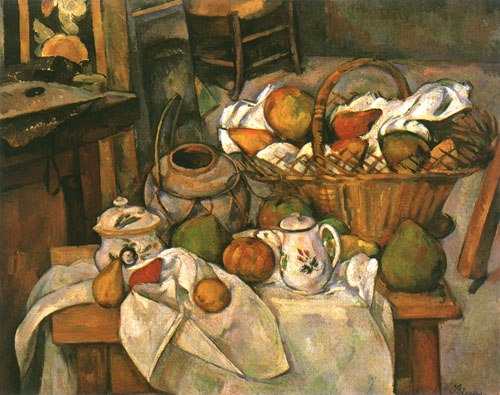
Which of these two paintings (Komm, Herr Jesus, sei unser Gast by Fritz von Uhde or Still Life with Fruit Basket by Paul Cézanne) is more religious? Well, according to Paul Tillich, who's example this is, it is the Cézanne Still life.

Tillich was not only one of the most creative theologians of the 20th century, he was also one of the very few (von Balthasar is another but very different example) major theologians that have dealt in depth with art.

So what does Tillich have against Uhde's painting of Jesus? Well, he says it lacks a "quality of sacredness". Tillich has this very interesting distinction between the content of a piece of culture (Inhalt) and it's true sense (Gehalt). The Uhde painting has a religious content, but, according to Tillich it is not religious because its form does not correspond with its Gehalt. In other words, it might be a religious image on the surface, but it is not religious in the proper sense because it is not painted in a way that communicates something about the Gound of Being.

The Cézanne painting on the other hand does not have a religious Inhalt, its only fruit, but, Tillich claims, there is something about the way the fruit is painted that opens up something in the observer, and this is a genuinely religious experience.

I know very little about art, but I still find this distinction very helpful, and I will at some point try to apply this and some other of Tillich's ideas about art to an art form more familiar to me: rock music.

Sunday, December 10, 2006

President Carter on Israel and Palestine

Since reading the Fisk book I have spent some time trying to make sense of the Israeli-Palestine conflict, something that is not easily done. One good source for one perspective is the Maan News Agency, which posts news from a balanced Palestinian perspective. They also offer very good commentary a opinion pieces, often republished stuff. Like this one, by former US President Carter.

It would be almost politically suicidal for members of Congress to espouse a balanced position between Israel and Palestine, to suggest that Israel comply with international law or to speak in defense of justice or human rights for Palestinians. Very few would ever deign to visit the Palestinian cities of Ramallah, Nablus, Hebron, Gaza City, or even Bethlehem, and talk to the beleaguered residents. What is even more difficult to comprehend is why the editorial pages of the major newspapers and magazines in the United States exercise similar self-restraint, quite contrary to private assessments expressed quite forcefully by their correspondents in the Holy Land.

Thursday, December 07, 2006

Patristics Carnival

The first instalment of the Patristics Carnival is on-line over at uperekperisou. Check it out.

Wednesday, December 06, 2006

Robert Fisk lecture

Adblock

Here is a four-part lecture by Robert Fisk based on his book. It's shorter than the 1300 pages, but still informative.

New Blog of the Month at Theology Blogs

This time, the honour goes to Dan.

Tuesday, December 05, 2006

Fisk's World


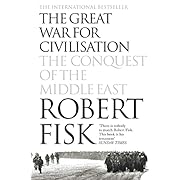
I recently finished reading Robert Fisk's monumental The Great War for Civilization: The Conquest of the Middle East. I cannot recommend it enough. It's 1300 pages of modern history of the most troubled part of our world, written by possibly the only person to have witnessed almost every key moment in the last 30 years in the region first-hand, from the Soviet invasion of Afghanistan to the current civil war in Iraq. Fisk shows how all these events are connected and in what ways the western powers are involved. But most importantly, he is always reporting from the viewpoint of the - mostly innocent - victims in all these conflicts.

The feeling one gets from reading this book is one the one hand a great sensation of learning - I can't remember the last time I learned so much new and important things about our world. On the other hand one feels a lot of outrage, not least directed towards the foreign policy of western powers that have done so much to make the situation worse, how much racism, violence, and, well, evil there is to found in the actions of various intelligence and military organisations.

Of course, Fisk does not fall into the trap of claiming that the leaders of the muslim world are innocent victims. Quite to the contrary, every gruesome crime committed by shahs, presidents and kings is treated in detail. But when it comes to the bigger picture - the roots of all the problems, it is hard to avoid the notion that most of the problems in the Middle East originate in the two European "World Wars" and their aftermaths. In a sense, Fisk shows that the WWI never really ended, it just moved to the east, where it is still being fought.

Fisk's job has been to write about war, and this is where his focus is. There is some irony in this. Even if Fisk has a lot to say about the role of bad journalism in these conflicts - in fact he shows that the Western media is a huge part of the problem - he seems to fail to recognize that the kind of journalism he himself represents also is part of the problem. Preferable as it is to have it done well as Fisk does, the kind of journalism that focuses on violent conflict has a huge part in the way we in the west always look at the Middle East.

Of course, one would wish that no one would make to many remarks about the middle east without having read this. But if anyone who reads this knows any major world leader, please, get him or her a copy of it for Christmas.

You can check out some of Fisk's writings at his paper the Independent, this unofficial homepage or at Wikipedia.

Santa

Andrew is to blame...

1. Egg Nog or Hot Chocolate? Hot Chocolate

2. Does Santa wrap presents or just sit them under the tree? Wraps them.

3. Colored lights on tree/house or white? White! I'm European!

4. Do you hang mistletoe on house? Nope. See number 3.

5. When do you put your decorations up? Depends... Things with lights in them (tasteful, European), go up in the beginning of December, more stuff comes later.

6. What is your favorite holiday meal (excluding dessert)? Not that big on Christmas food, actually. Mom's meatballs are good.

7. Favorite Holiday memory as a child? When I was a kid, dad used to play this record with this amazing Austrian boy's choir to wake us up on Christmas morning. I think that is the reason that all Christmas music sounds corny in my ears.

8. When and how did you learn the truth about Santa? I was never lied to.

9. Do you open a gift on Christmas Eve? Yes, all of them, that's the Finnish tradition. Christmas day you go to Church and visit relatives.

10. How do you decorate your Christmas Tree? Tastfully. Se number 3.

11. Snow! Love it or Dread it? Love it in reasonable amounts.

12. Can you ice skate? If someone puts a gun to my head.

13. Do you remember your favorite gift? Not really.

14. What's the most important thing about the Holidays for you? Since my dad died Chrismas is sort of spoiled for me, but I always look forward to going to Church on Christmas morning to sing the wonderful hymn "Dagen är kommen" Quick translation: "The day has arrived: Love triumphs!" I seldom feel so thoroughly Christian.

15. What is your favorite Holiday Dessert? Rice a' la Malta

16. What is your favorite holiday tradition? Church

17. What tops your tree? A star

18. Which do you prefer: giving or receiving? Giving.

19. What is your favorite Christmas Song? See 14

20. Candy Canes! Yuck or yummy? ????

21. Favorite Christmas Movie? Oh dear... I don't think I have one.

22. What would you most like to find under your tree this year? The ability to speak Arabic.

23. Favorite Holiday memory as an adult? No, apart from the Church bit Christmas is not my favourite time of the year.

Monday, December 04, 2006

A Change is Coming

I have decided to cut down on the time spent on this blog substantively. From now on I will only post if I feel I have something that I want to post here, I will not try to come up with a semi-daily post in order to... well, why do we do that?

That's the point, and this is my first reason, I recognized that a big motivation for me to post as much as I have has been to accumulate traffic, maybe in order to compare myself to other theology-bloggers and so on. Since I feel this tendency in our society, to measure and compare - to compete - is a very major part of what is wrong in the world, I feel I need to for myself abstain for activities that feeds this tendency in my life.

A second reason is that I started this blog for the specific purpose of working out what I have called "Ideas for a Theology of Decline". I have finished that and now I don't really have a motivation to keep it up beyond what I mentioned above.

A third reason is that I am thinking about a starting work on a project that I may want to publish at some point, in Swedish, and I want to use the time I have recently used on this blog on that. I might post some translations at some point if I like feedback on something, but the majority of it will take place of the Internet.

I will not completely discontinue God in a Shrinking Universe, though, so don't cancel those bookmarks yet. I have a post on Tillich's theology of art and Rock music brewing, and some (well a lot actually) of thoughts that have been sparked by reading Robert Fisk's majestic book on the Middle-East. And some other stuff. But this will in the future appear like once a week instead of once a day.

So now you know.